
Why Your AI Content Sounds Like Everyone Else's
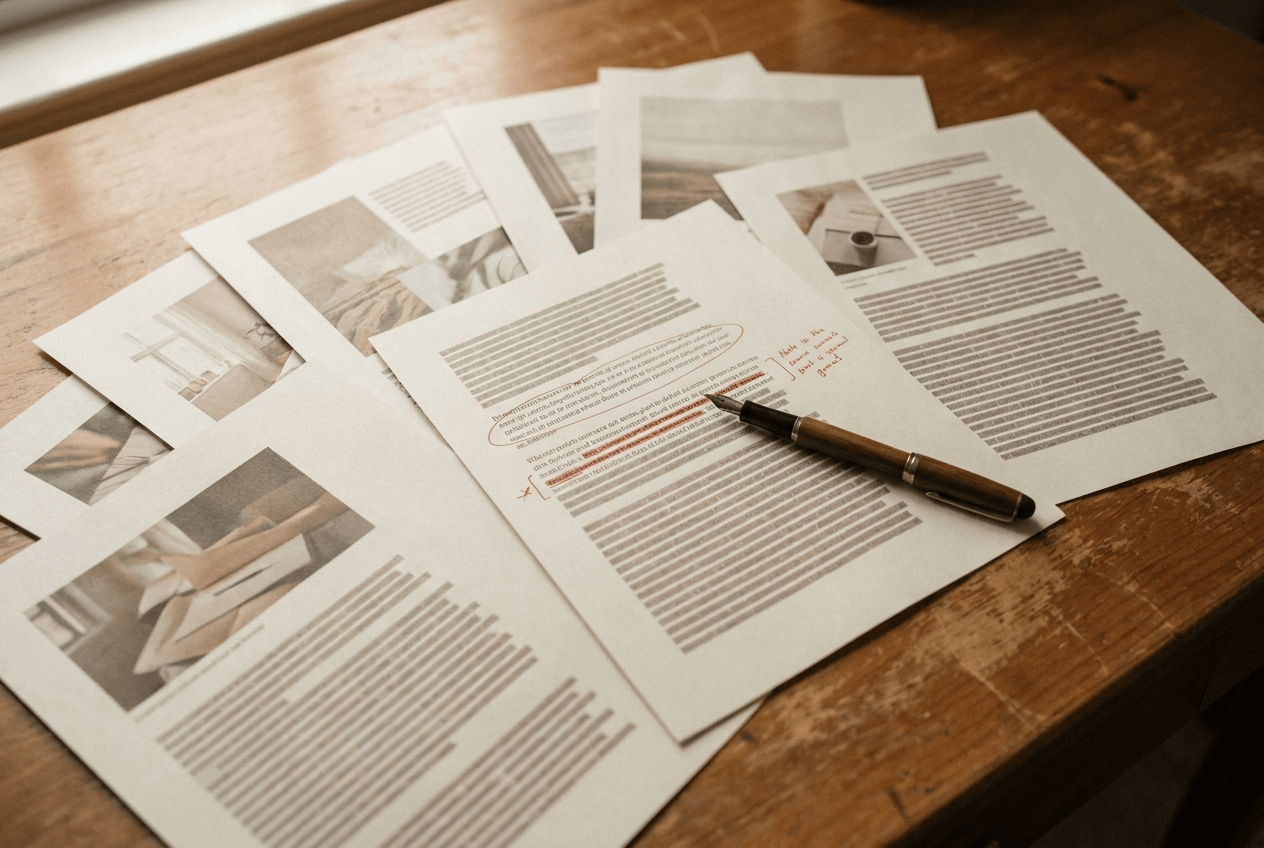
You've felt it without being able to name it: that flicker of déjà vu scrolling Instagram, like you already read this post somewhere else last week. Open three business blogs in the same industry and the paragraphs hit the same beats, in the same order, landing on the same reassuring note. Even the email subject lines have started to blur together and you start to finish the sentence before you even open the email.
None of it is wrong, exactly. It's just interchangeable. Swap the logo and you'd never know which company wrote it. Somewhere in the last two years, a lot of small businesses started sounding like the same business. That's not a coincidence, and it's not because AI is bad at writing. It's because most people are using it the same way — and getting the same result.
The Google reflex
Most people prompt AI the way they'd Google something. Type a question, take the first answer, move on. That instinct makes sense since it's how we've all searched for information for twenty years. But generating content isn't the same task as retrieving it, and treating a language model like a search bar produces exactly what you'd expect: the average of everything it's ever seen.

That's not a criticism of the technology. It's a description of how it works.
A model trained on the internet's entire body of marketing copy, business blogs, and Instagram posts will, left to its own devices, gravitate toward the most statistically common way of saying something.
Common phrasing. Common structure. Common cadence.
That's the whole mechanism, and it's precisely why unedited AI output tends to sound like it was written by no one in particular.
Ask it for a blog post about "the benefits of AI content" with no further direction, and it will hand you the most average version of that post that exists. Ask a hundred businesses to do the same thing, and you'll get a hundred slightly different wrappers around the same underlying piece.
Sameness has a cost
Picture two competitors in the same industry, both using AI, both publishing content that's perfectly fine. A prospect has both tabs open, comparing. Nothing on either page gives her a reason to pick one over the other since the tone's the same, the promises are the same, even the stock photography feels interchangeable. So she does the only rational thing left: she picks whichever one is cheaper.
That's the cost. It doesn't show up as an error message or a bounce-rate spike you can point to. It shows up as silence when the deal that goes to a competitor for reasons nobody can quite name, the content that gets published and generates nothing, the newsletter that used to get replies and now just gets opened, if that.
Buyers scroll past it because their brain has learned to filter it out, the same reflex that makes hotel lobby art and elevator music functionally invisible after the first five seconds. Nobody consciously decides to ignore it. The brain just stops registering it as information worth the effort, and content that reads like everything else in the feed gets sorted into that same category before anyone's finished the first sentence.
Search engines are starting to behave the same way. As more of the web gets written by the same handful of models with the same defaults, pages that restate the industry consensus are competing against thousands of other pages saying the same thing in slightly different words. The ones that actually rank are increasingly the ones with a specific point of view — something a search engine, like a reader, can tell apart from the noise around it.
And then there's the plainest cost of all: price. When two businesses look interchangeable on the page, the prospect has no rational reason to pay more for one over the other. So the conversation moves to price, which is the one place a small business or specialty business almost never wants to compete as it's the place where the biggest player with the thinnest margins always wins.
Efficiency without judgment produces sameness. And sameness is the fastest way for a small business to disappear, not with a dramatic collapse, but the way a shop on a block quietly stops being the one people think to visit.
The one shift
The businesses actually winning with AI right now aren't using a better prompt. They're using the model differently: as a fast collaborator working underneath a real editorial process, instead of a replacement for having one.

Bluntly, that means the AI never touches the keyboard first. A person with a defined point of view — a real opinion about the industry, specific examples instead of generic claims, a brand voice that's been thought through rather than defaulted to — sets the direction. The model executes inside that direction.
Then a person edits the output with the same judgment they'd apply to a junior writer's first draft: cutting the generic lines, sharpening the specific ones, and making sure the piece actually sounds like someone who knows what they're talking about, because it was written under the supervision of someone who does.
That's the shift. Not a smarter prompt. Creative direction first, AI execution second — never the reverse.
The businesses quietly abandoning AI content, on the other hand, tend to have skipped that step. They generated, published, and watched the results underperform — then concluded that AI content "doesn't work" for their industry. It's rarely the tool. It's that nobody brought a point of view to the process, so the process defaulted to the average.
What this actually looks like
None of this requires a content team or an enterprise budget. It requires deciding, before you generate anything, what you actually think — about your industry, your customers, the thing everyone else in your space gets wrong — and making sure that opinion survives the editing pass. AI can draft faster than any writer alive. It cannot supply the point of view. That part is still, and will likely remain, a human job.
If you're prompting AI the way you'd Google something, you're going to get Google's average answer, dressed up as your content. The fix isn't more AI. It's more judgment applied to it.
